



Communication
In a general meaning, we understand the term ‘communication’ as the process in which a message is transmitted between two or more participants. Depending on the means which are used to transmit the message, we can distinguish between ‘verbal communication’ and ‘non-verbal communication’, which is often called ‘body language’ although non-verbal communication includes more things than body language alone.
When we learn a foreign language, we obviosly learn ‘verbal communication’ because this is the most important means of communication among human beings, but we should also learn ‘non-verbal communication’ because, like words, body language usually differs from one culture to another.
The text in this section describes the characteristics of non-verbal communication and explains some differences with other cultures. This will help us understand other people better.
Reading: non-verbal communication
In general terms, we could describe communication as the process in which we send or exchange information by means of speech, writing or signs. The different ways of transmitting a message have given rise to two types of communication: verbal communication and non-verbal communication.
Verbal communication is the process in which information is exchanged through the use of sounds. These sounds are usually assembled to form words, and these words are organised in sentences in accordance to the syntactical rules of a particular language. For this reason, verbal communication is commonly used as a synonym of articulated language (like English, Catalan, Spanish or French, for example), but it also includes such unarticulated sounds as a baby’s crying or a shout of pain, which are also forms of verbal communication.
On the other hand, non-verbal communication refers to the communicative process in which the information is transmitted by means of what is called body language, which includes gestures, body position, face expressions and specific behaviour. In our daily life, we normally use a combination of verbal and non-verbal communication.
When we speak of communication, we usually think of language, that is, we think of verbal communication. However, non-verbal communication is often more important than language itself. For this reason, understanding non-verbal communication is very important when we have to deal with other people in our daily work because this type of communication can reinforce our messages or it can conceal the messages that we do not want to transmit. Non-verbal communication covers a range of factors, which include body language, tone, appearance and physical surroundings.
Body language is very much used in the sales field, for example. Salespeople are trained to observe and interpret the body language of potential customers in order to understand their non-verbal signals and so increase the probability of sales success. The careful control of body position, eye contact and hand movements will contribute to a better communication with the public. For this reason, it is very important to control your non-verbal communication skills. The figure below shows some examples of body language.
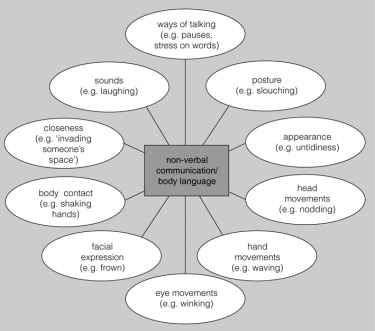
Some behaviours are considered positive as they are commonly seen as encouraging communication, whereas others are considered negative because they show anxiety, aggressiveness, boredom and other negative feelings. Direct eye contact, scratching your nose, arms crossed on chest, standing with hands on hips, sitting with your legs apart, placing your hand on your cheek, open palms, drumming fingers, tilted head… these are all examples of negative and positive feelings transmitted by body language. Therefore, it is very important to control these gestures and use them consciously to transmit the appropriate message in each specific situation. However, focusing on body language alone can cause some misunderstandings.
There are other aspects which we should consider, as for example personal space. When two people are talking to each other, they tend to stand at a specific distance apart. The average personal distance is different from one culture to another, but it also depends on the relationship between the people. In general, in the Anglo-Saxon cultures people tend to require more personal space than in Latin cultures, where the distance is smaller and people usually feel more comfortable standing closer to each other.
Another issue to take into account when we want to communicate effectively is physical contact. In Anglo-Saxon cultures, touching the other person while speaking is considered a bit too intimate for casual acquaintances and may lead to discomfort for the person with whom we are talking, whereas in Latin cultures there is a greater tendency to touching the other person.
Learning a foreign language does not only mean to practise the different skills and learn the words and grammar rules, but it also means to control the body language that is used in a particular context.
Language notes
- Expressing the means: to express how an action is done, we have different possibilities in English. In the text, we can see examples with the expression by means of (Cat. mitjançant) and with the preposition through (Cat. a través de): we exchange information by means of speech, writing or signs; information is transmitted by means of what is called body language; information is exchanged through the use of sounds. By means of and through are followed by a noun. Another way of saying how we do an action is with: by + verb (ending in -ing): In non-verbal communication we transmit our message by using body language.
- Expressing reason: to express the reason why we do something, we can use the conjunctions as (Cat. ja que) or because (Cat perquè). We can see some examples of this in the text: Some behaviours are considered positive as they are commonly seen as encouraging communication; other behaviours are considered negative because they show anxiety. In both cases, the conjunction is followed by a clause (remember that a clause is composed of: subject + verb + complements). If we want to express the reason with a noun, the correct conjunction is because of (Cat. degut a, a causa de): We didn’t understand him because of language barriers. We can combine these forms to add variety to a text.
- Prefix mis-: the prefix mis- is added to a verb or a noun. It has the meaning of ‘wrong’ or ‘wrongly’. There is an example in the text: misunderstanding (Cat. manca de comprensió), from the verb to misunderstand (Cat. entendre malament). Other examples: to misplace (Cat. posar al lloc equivocat), to misbehave (Cat. portar-se malament), to mispronounce (Cat. pronunciar malament).
- Prefix un-: this prefix is added to adjectives and verbs to indicate the opposite quality or action. In the text, we can see the example unarticulated (Cat. inarticulat). Other examples: to undo (Cat. desfer), unthinkable (Cat. impensable), uncertain (Cat. incert/a). This prefix may sometimes take the form in- or im-, as in incredible (Cat. increïble) and impossible (Cat. impossible).
- Language: this word has the double sense of the human capacity of communication through the use of words (Cat. llenguatge) and the particular language of a group of people (Cat. llengua, idioma). On the other hand, the organ is called tongue (Cat. llengua). Notice the expression mother tongue (Cat. llengua materna). There is also the term idiom (Cat. refrany), which you should not confuse with the Catalan and Spanish word idioma.
Glossary of terms: communication
- acquaintance: conegut/da (persona)
- appearance: aparença, aspecte
- articulated: articulat/da, ordenat/da
- behaviour: comportament
- body language: llenguatge corporal
- communication: comunicació
- communicative: comunicatiu/va
- discomfort: incomoditat
- facial expression: expressió de la cara, gest facial
- gesture: gest
- issue: aspecte, qüestió
- information: informació
- language: idioma, llengua
- message: missatge
- misunderstanding: confusió, malentès
- non-verbal communication: comunicació no-verbal
- personal space: espai personal
- physical surroundings: entorn físic
- process: procés
- sign: signe
- signal: senyal
- sound: so
- speech: parla, discurs
- to assemble: organitzar, articular, ordenar, ajuntar
- to communicate: comunicar
- to conceal: amagar, ocultar
- to encourage: animar, fomentar
- to exchange: intercanviar
- to give rise to: originar
- to interpret: interpretar
- to reinforce: reforçar
- to take into account: tenir en compte
- to transmit: transmetre
- tone: to (de la veu)
- unarticulated: inarticulat/da, no ordenat/da
- verbal communication: comunicació verbal
Communication: instructions and commands
There is a specific type of language that is used in certain situations. This language is sometimes called social language and it is composed of some words and expressions which are used for a variety of purposes, as for example, to give instructions, to give commands, to make suggestions, to make an invitation, to make a request, to give advice or to express wishes and opinions.
Giving instructions means explaining someone how to do certain tasks. We can give instructions to operate a machine, to do a certain task, to cook a dish or to go to a certain place, and although the vocabulary changes in each situation, the way of giving the instructions remains the same. On the other hand, a command (also called an order) is very much the same as an instruction, but the meaning is more intense.
Both for instructions and commands, we must use a form of the verb called the imperative.
Instructions and commands
The most common way of giving instructions and commands is by using the imperative form of the verb.
Instructions:
The imperative form
The main characteristics of the imperative are:
- It has the same form as the infinitive: work!.
- The negative is formed by adding do not (don’t) before the verb: don’t work!.
- The sentence has no explicit subject (but the implicit subject is you).
- In the written form, we must add an exclamation mark (!) at the end of the sentence.
- We often use the word please to soften the command: work please!.
Here is an example of a text giving some instructions to send an email (the imperative forms are in bold type):
How to send an email
First of all, locate your email program (Outlook, G-Mail, Thunderbird, etc.) in your computer. Click on the icon to run the program and a text editor will appear. Type the receiver’s address in the word field called “To…” and next type the subject of your message in the corresponding field. After this, write the text of your message in the text editor. When you finish, review the spelling and check if there are any mistakes. Finally, click on the button “Send” and the message will reach its destination in a few seconds.
When you give instructions, especially in a written text, it is very important to make a good use of connectors. In written instructions, you will generally need time connectors. Notice the connectors in our example (in bold type):
How to send an email
First of all, locate your email program (Outlook, G-Mail, Thunderbird, etc.) in your computer. Click on the icon to run the program and a text editor will appear. Type the receiver’s address in the word field called “To…” and next type the subject of your message in the corresponding field. After this, write the text of your message in the text editor. When you finish, review the spelling and check if there are any mistakes. Finally, click on the button “Send” and the message will reach its destination in a few seconds.
Another way of giving instructions is with the modal verbs should or must. By using should, you are in fact giving advice, or recommending things to do. With must, you are implying an obligation, so you can use this modal verb when you think that the instruction is very important.
Here is the text of our example with modal verbs:
How to write an email
First of all, you must locate your email program (Outlook, G-Mail, Thunderbird, etc.) in your computer. Then you should click on the icon to run the program and a text editor will appear. Now you should type the receiver’s address in the word field called “To…” and next (…) the subject of your message in the corresponding field. After this, you must write the text of your message in the text editor. When you finish, you should review the spelling and check if there are any mistakes. Finally, you must click on the button “Send” and the message will reach its destination in a few seconds.
You can respond to a person giving you instructions with a variety of expressions. For example, you can say:
- Ok, thank you, I’ll do that (Cat. D’acord gràcies, així ho faré).
- Yes, great, thanks for telling me (Cat. Perfecte, gràcies per explicar-m’ho).
- Thanks a lot (Cat. Moltes gràcies).
- I’m sorry, but I’m afraid I can’t do that (Cat. Em sap greu però això no ho puc fer).
Commands:
We give a command when we need someone to do something immediately, or when we think that it is very important, but we can only give commands in informal situations. In formal situations, or when we are talking to a superior, we must make a request.
A command, which is usually accompanied by an imperative tone of voice, often implies a certain degree of impatience.
Examples of commnands are:
- Come here! (Cat. Vine aquí!)
- Sit down! (Cat. seu!)
- Take off your cap! (Treu-te la gorra!)
- Go! (Cat. Ves-te’n!)
- Give me alone! (Cat. Deixa’m en pau!)
- Don’t shout! (Cat. No cridis!)
- Don’t talk to me like that! (Cat. A mi no em parlis d’aquesta manera!)
- Shut up! (Cat. Calla!)
We can add please to soften the command: come here please!, don’t shout please!, please, shut up!.
We can respond to a command like this:
- Yes, sir/madam (Cat. Sí, senyor/senyora)
- Yes, of course (Cat. Sí, és clar)
- No, I won’t (Cat. No ho penso fer)
- Of course I won’t (Cat. Ni pensar-ho!)
Directions
Sometimes, we must give instructions to go to a certain place. This is called giving directions. To give directions, we normally use the imperative form of the verb together with certain words and expressions which are especific of this context.
Asking for directions:
We can ask for directions in the following way:
When you want to call somebody’s attention, in English you must use the expression excuse me (Cat. Perdoni, disculpi).
- Excuse me, how can I go to a bank? (Cat. Perdona, com puc anar a un banc?).
- Excuse me, can you tell me the way to the bank? (Cat. Perdona, em podries dir com anar a un banc?).
- Excuse me, is there a bank nearby? (Cat. Perdona, hi ha un banc per aquí?)
Giving directions:
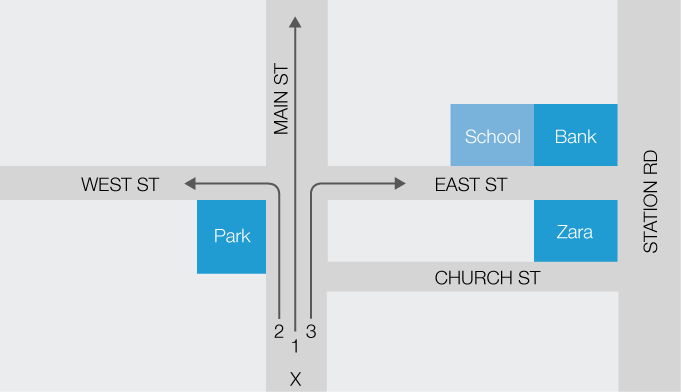
The three basic expressions to give directions are (see the map):
- (1) Go straight ahead (Cat. Vés recte)
- (2) Turn (first) left (Cat. Gira (pel primer carrer) a l’esquerra).
- (3) Turn (second) right (Cat. Gira (pel segon carrer) a la dreta).
With these three directions you can direct a person anywhere, but there are others which are also very useful. For example:
- Go/walk along (West St.) (Cat. Vés/Camina per [West St.]).
- Go/walk across (West St.) (Cat. Travessa [West St.]).
- Turn left/right into (West St.) (Cat. Gira a l’esquerra/dreta [per West St.])
- Take (West St.) (Cat. Agafa [West St.]).
- Turn left/right outside (the bank) (Cat. Gira a l’esquerra/dreta en sortir [del banc]).
- Go straight on (Cat. Continua recte).
- Go straight on until you come to (West St.) (Cat. Continua recte fins a [West St.]).
Go straight ahead vs go along…
Go straight ahead is an adverbial expression that indicates the direction of the movement (Go straight ahead and turn left). Go along… is a prepositional phrase that requires the name of the street (Go along West St). It is wrong to say: Go straight ahead West St.
Until vs until you come to…
Until (Cat. fins) is a preposition of time which is only used with time adverbials. For example: until 6 oc’lock, until the evening, until 2019, etc. It is wrong to say: until West St).
When giving directions, we must use the expression until you come to… when we refer to a point in space. For example: Go straight ahead until you come to West St.
When giving directions, the common pattern is first to show the way and then to explain the location of the place. Some common expressions to indicate location are (see map for reference):
- In…street (Cat. al carrer…): The bank is in East St.
- On the corner of…* (Cat. a la cantonada de…): The park is on the corner of West St and Main St..
- Next to … (Cat. al costat de…) The school is next to the bank.
- Opposite … (Cat. davant de…) The bank is opposite Zara
- Near … (Cat. a prop de… a la vora de…): The school is near Zara.
- Between … (Cat. entre…): The school is in East St between Main St and Station Rd.
- At the end of… (Cat. al final de…): The bank is at teh end of East St.
- Round the corner (Cat. al girar la cantonada): Zara is round the corner.
The names of the streets
Common abbreviations added to the name of the streets are:
- St: street
- Rd: road
- Ave: avenue
- Sq: square
The names of the streets are proper names, so we must always write them with a capital letter. The abbreviation is part of the name, so it is also written with a capital letter (West St, Station Rd).
When we talk about the names of the streets, we must not say or write the article the. For example: the school is in East St. It is wrong to say: the school is in the East St. But we must write the article when street is a common name. For example: The bank is at the end of the street.
Sometimes we may also need to show the way inside a building or within a company’s premises. Here are some common expressions which we can use in this situation:
- Take the lift (Cat. Agafa l’ascensor).
- Go up/down to (the second floor) (Cat. Puja/baixa al [segon pis]).
- Go to the end of the corridor (Cat. Vés fins al final del passadís).
- It’s the (third) door on the left/right (Cat. És la [tercera] porta a l’esquerra/dreta).
- Go across the courtyard (Cat. Travessa el pati).
- It’s on the (second) floor (Cat. Està en el [segon] pis).
- It’s in the hall (Cat. És al vestíbul).
- It’s next to the reception desk (Cat. Està al costat de la recepció).
- Ask at the reception desk (Cat. Pregunta a recepció).
Now read the following conversation as an example (see map for reference):
Asking for and giving directions in the street
Jordi is in London. He asks Phil for directions to go to a bank.
Jordi: Excuse me, is there a bank nearby?
Phil: Yes, there’s one in East St.
Jordi: Good, how can I go there?
Phil: Well, go straight ahead and then turn second right. That’s East St. Go straight on until you come to Station Rd. The bank is on the left, on the corner with Station Rd and next to a school.
Jordi: Ok, so I go straight ahead and then second right, is that it?
Phil: Yes, that’s right.
Jordi: Thank you very much.
Language notes:
- Notice the use of the imperative form to give directions (Go straight ahead, etc.). Do not use must or should in this situation.
- Nearby (Cat. a prop): this is an adverb. Do not confuse with the preposition near, which requires a noun (near the school).
- Is that it? (Cat. és això?): this expression is used to confirm that you understood correctly. Notice Phil’s answer to this small question.
Grammar reference: speaking about the future
In English, there is no specific verb tense to speak about the future, but we can refer to future events by using a modal verb (will), the expression be going to or even the present continuous and present simple tenses.
The future with 'will'
We normally express the future with the modal verb will. The syntactical structure is the following:
- WILL + BASE FORM
Conjugation of the future with ‘will’:
The following table shows the conjugation of the verb work in the future with will:
| Affirmative Long form | Short form | Negative Long form | Short form | Interrogative | |
|---|---|---|---|---|---|
| I | will work | ‘ll work | will not work | won’t work | Will I work? |
| You | will work | ‘ll work | will not work | won’t work | Will you work? |
| He/She/It | will work | ‘ll work | will not work | won’t work | Will he/she/it work? |
| We | will work | ‘ll work | will not work | won’t work | Will we work? |
| You | will work | ‘ll work | will not work | won’t work | Will you work? |
| They | will work | ‘ll work | will not work | won’t work | Will they work? |
Notes:
- Will has short forms in the affirmative and in the negative. In negative, the short form is won’t (=will + not).
- The modal will is the same for all persons.
- As all modals, will is used in the same way as an auxiliary verb, adding not in the negative and changing the order S-V in the interrogative.
Use of the future with will:
We use the future with will:
1) To give information about the future:
- They will go on strike tomorrow. (Cat. Demà faran vaga).
- Will you come to work next Monday? (Cat. Vindràs a treballar el dilluns que ve?).
- I will retire next year. (Cat. Em jubilaré l’any que ve).
- I will be 38 next week. (Cat. La setmana que ve compliré 38 anys).
2) To make predictions and talk about what we think or guess that will happen:
- It will rain all the week (Cat. Plourà tota la setmana).
- I think that I will stay at home tonight (Cat. Crec que em quedaré a casa aquesta nit).
- I’m sure that you will all pass the exams (Cat. Estic segur que tots aprovareu els exàmens).
- I guess that you will come, won’t you? (Cat: Suposo que vindràs, no?).
3) In conditional sentences, to say what will happen if the condition becomes true:
- If I pass the exams, I will be very happy (Cat. Si aprovo els exàmens, estaré molt content).
- What will you do if you are fired? (Cat. Què faràs si et despatxen de la feina?).
4) In a series of interpersonal meanings to express requests, offers, promises, etc.
- Will you come here, please? (a request) (Cat. Pots venir, si us plau?).
- Don’t worry, I’ll help you with your English (an offer or a promise) (Cat. No t’amoïnis, t’ajudaré amb l’anglès).
When say what we think that will happen in the future, we often use an expression to explain how we conceive the future event. Some of the expressions commonly used for this are:
- I’m sure that … (Cat. Estic segur que …)
- I think that … (Cat. Crec que…, opino que …)
- I believe that … (Cat. Crec que …)
- I’m sure that … (Cat. Estic segur que …)
- I’m not sure that … (Cat. No estic segur que…)
- I’m convinced that … (Cat. Estic convençut que …)
Time adverbials:
We commonly use the will-form with time adverbials that refer to the future. For example:
- Tomorrow (Cat. demà): Tomorrow I’ll call you tomorrow, is that ok?
- Next week, next month, etc. (Cat. la setmana que ve, el mes que ve, etc.): I think she’ll be 60 next year.
- Tonight (Cat. aquesta nit): it won’t rain tonight so we can go out.
- In the future (Cat. en el futur): in the future, we’ll do everything with computers.
- One day (Cat. un dia): you will understand me one day, don’t worry.
The future with 'be going to'
In this form of the future, we must conjugate the verb be in the present simple. The syntactical structure is the following:
- AM/IS/ARE + GOING TO + BASE FORM
Conjugation of the future with be going to:
The following table shows the conjugation of the verb work in the be going to-form.
| Affirmative Long form | Short form | Negative Long form | Short form | Interrogative | ||
|---|---|---|---|---|---|---|
| I | am going to work | I’m going to work | am not going to work | I’m not going to work | Am I going to work? | |
| You | are going to work | You’re going to work | are not going to work | aren’t going to work | Are you going to work? | |
| He/She/It | is going to work | He’s/She’s/It’s going to work | is not going to work | isn’t going to work | Is he/she/it going to work? | |
| We | are going to work | We’re going to work | are not going to work | aren’t going to work | Are we going to work? | |
| You | are going to work | You’re going to work | are not going to work | aren’t going to work | Are you going to work? | |
| They | are going to work | They’re going to work | are not going to work | aren’t going to work | Are they going to work? |
When we use the verb to go in this form of the future, we can omit the base form go in order to avoid repetition, so we can say: I’m going out tonight instead of I’m going to go out tonight.
Notes:
- Be going to has short forms in the affirmative and in the interrogative.
- The expression going to and the base form of the verb are invariable. The only element that changes is the verb be, which agrees with the subject.
Use of the future with be going to:
We use the future with be going to:
1) To express a future event which is already planned and decided:
- We are going to buy a new car next year (Cat. L’any que ve comprarem un cotxe nou).
- Are you going to study for the exam tonight? (Cat Estudiaràs per a l’examen aquesta nit?).
- I’m going (to go) to France next summer (Cat: El proper estiu aniré a França).
2) To predict the future on the basis of present evidence and say that something will happen very soon in the future.
- She is going to have a baby in May (Cat. Tindrà un bebè al mes de maig).
- Look at those clouds! It’s going to rain (Cat. Mira aquells núvols! Està a punt de ploure).
Time adverbials:
The future forms with be going to are commonly used with some time adverbials that refer to a near future. For example:
- Tomorrow (Cat. demà): Tomorrow I’m going to stay until 10 in the evening .
- Next week, next month, etc. (Cat. la setmana que ve, el mes que ve, etc.): he’s going to start next week.
- Tonight (Cat. aquesta nit): are you going to have dinner at home tonight?
The future with the present simple and the present continuous
We can use the present simple and the present continuous tenses to speak about the future. In this case, the sentence must include a reference to the future (tomorrow, tonight, etc) to distinguish the verb tense from its present meanings.
The present simple:
The present simple with a future meaning is used to:
1) Speak about future events which are part of a timetable or a regular schedule:
- The sun sets at 7:34pm tomorrow (Cat. Demà el sol es pon a les 7:34 de la tarda)
- The classes start at 8 next Monday. (Cat. El proper dilluns les classes comencen a les 8)
- What time does your train leave tomorrow? (Cat. A quina hora surt el tren demà?)
- Do you work next weekend? (Cat Treballes el proper cap se de setmana?)
The present continuous:
The present continuous with a future meaning is used:
1)To express arrangements and fixed plans, when the time and date have already been decided. For example:
- What are you doing this evening? (Cat. Què fas aquesta nit?, què tens pensat fer aquesta nit?).
- I’m staying at home tonight (Cat. Aquesta nit em quedaré a casa).
- He’s retiring next year. (Cat. L’any que ve es jubila; l’any que ve té la intenció de jubilar-se).
The future with be going to and with the present continuous
There is very little difference between the be going to-form and the present continuous. We can say: I’m going to stay at home tonight and I’m staying at home tonight with no difference in meaning.
However, when we need to express decisions and intentions, we normally use the be going to-form. When we speak about fixed arrangements, we prefer the present continuous. Compare these sentences:
- I’m going to cook today (Cat. Avui cuinaré jo) (The emphasis is on the intention; the idea is: it’s my intention to cook).
- I’m cooking today (Cat. Avui cuino jo) (The emphasis is on the arrangement; the idea is: it has been decided that I’m cooking today, so I will cook)
Other forms of the future
Other forms of expressing the future are the future continuous and the future perfect. Their use is the same as in all the continuous and perfect tenses, but the action takes place in the future. The syntactical structures of these forms are the following:
- Future continuous: WILL + BE + GERUND (-ING): I will be working.
- Future perfect: WILL + HAVE + PAST PARTICIPLE: I will have worked, I will have gone.
'Will' vs 'be going to'
The main difference between the future with will and the future with be going to is the intentionality of the action. If we need to express our intention of doing something, we must use the be going to-form; if we just want to express something that will happen independently of our intention, we must use will. Compare these sentences:
- I’m going to help you (=I have thought about it and it is my intention to help you).
- I will help you (=I didn’t think about it, but I will help you; I take the decision at the moment of speaking).
For this reason, when speaking about a person’s age, we must always use ‘will’:
- I will be 50 next week (Cat. La setmana que ve compliré 50 anys).
It is wrong to say: I’m going to be 50 next week.